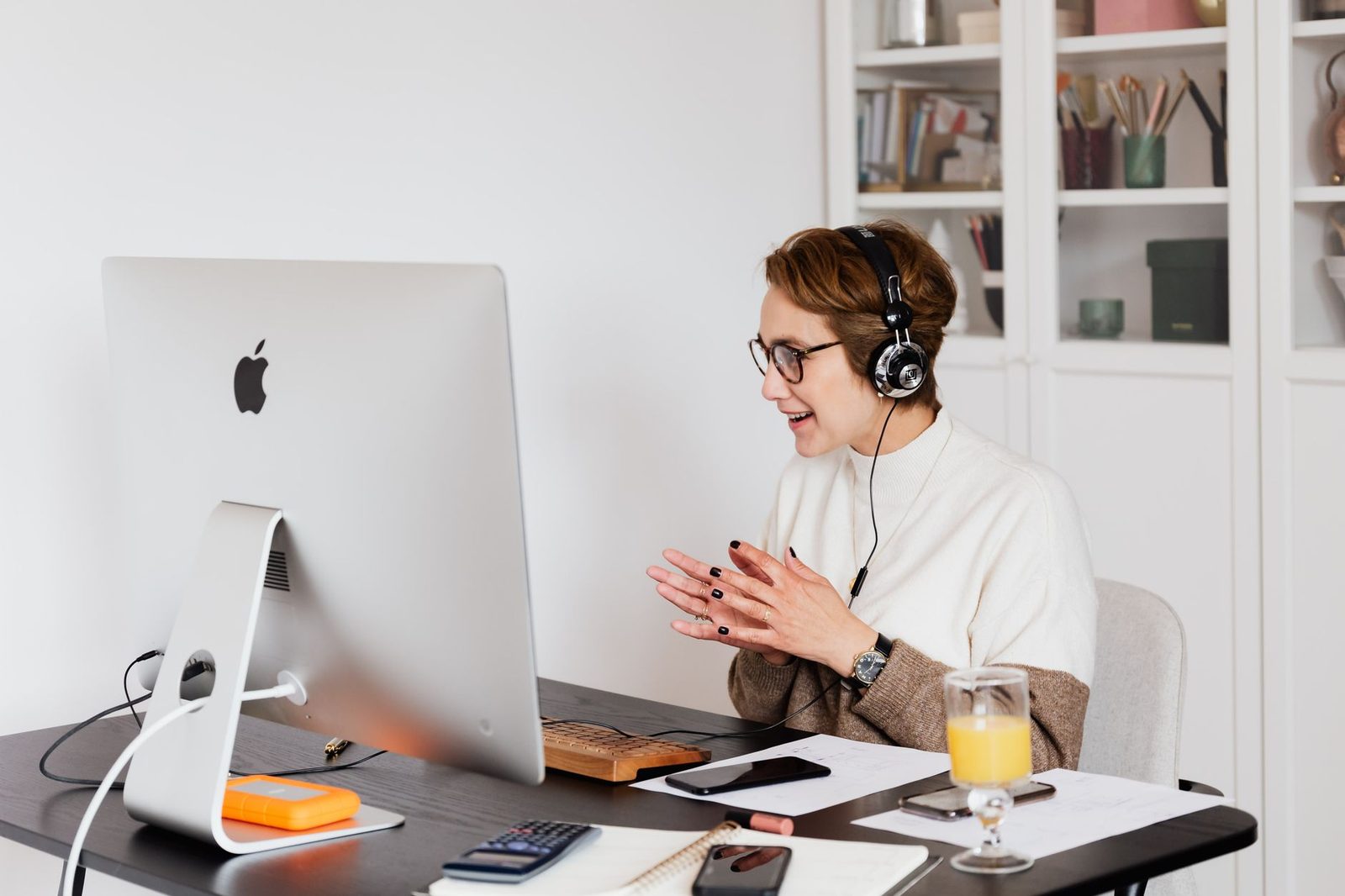
All random video chat advice stops at the image. Light your face, clean up your background, mind your framing, prepare an opening line. Then comes the moment you have to open your mouth — and that's where most conversations die, not because of what was said, but because of how it was said.
The voice arrives a fraction of a second after the image, and it says far more. A face can be flattered by good lighting; a tight voice, too quiet, too fast, or muffled by a poor microphone cannot be made up. The stranger on the other side isn't analysing anything: they feel a vague discomfort, and their finger drifts towards the next button.
This article takes that blind spot seriously: why nerves lodge first in the larynx, what your speaking pace reveals about you despite yourself, how to warm up your voice in three minutes before a session, and how to sort out the hardware side without spending a fortune.
Nerves aren't seen, they're heard
When you dread an interaction, the body prepares for effort: breathing becomes shallow and chest-based, the neck and shoulder muscles tighten, the mouth dries out. All three reactions hit the vocal apparatus directly.
Short breath shortens sentences: you speak in bursts of four or five words, you break in the wrong places, you snatch air in the middle of a clause. Neck tension pushes the pitch of the voice up and makes it thinner. A dry mouth adds tongue clicks and throat clearing.
None of this is consciously registered by the person you're talking to. What they register is an overall impression: "this person isn't comfortable", therefore "this person is going to cost me energy". In an environment where one click brings up somebody else, the impression is enough.
Speech therapists and spoken-voice professionals — the people who train actors, teachers and call-centre staff — work on precisely these three levers: breath anchoring, laryngeal release and hydration. The Collège français d'ORL et de chirurgie cervico-faciale notes, in its recommendations on functional dysphonia, that most spoken-voice disorders in healthy individuals stem from poor vocal technique rather than any lesion.
The good news is that the voice is a muscle driven by breath. Unlike the face, it can be corrected in a handful of conscious training sessions.
The four signals your voice sends in ten seconds
In a cam-to-cam exchange, the first ten seconds carry four decisive pieces of vocal information. Knowing them lets you fix them one by one.
Volume
Too quiet is shy users' number one flaw. You speak as if someone were asleep in the next room — which is sometimes literally the case. The stranger turns up their device, then hears all your room's background noise along with you, and gives up.
The useful instinct: speak as if the person were two metres away, not twenty centimetres. That isn't shouting, it's engaging the breath.
Pace
Nerves speed things up. A comfortable speaking rate in relaxed conversation sits somewhere around 150 to 180 words per minute. Under stress, it easily climbs past 220, with sentences crashing into one another.
A fast pace has a perverse effect on video chat: it removes the silences the other person could step into. You fill the whole sound space, your partner has no way in, and they drop out.
Pitch
A voice drifting upward signals tension. The remedy isn't to force a lower register — that sounds fake and it's tiring — but to release the jaw and the neck. A grounded voice drops on its own.
The opening words
"Hello?" "Uh… hi?" "Is your mic working?" These hesitant openings place the conversation on technical uncertainty instead of human ground. Preparing three affirmative openings — not witty, simply affirmative — dramatically changes your retention rate.
| Vocal signal | What the stranger understands | Immediate fix |
|---|---|---|
| Volume too low | I'm intruding, I'm not sure I want to be here | Speak "at two metres", straighten up |
| Pace > 200 words/min | I'm stressed, I'm filling the void | Finish your sentences, accept two seconds of silence |
| High-pitched voice | I'm tense | Release the jaw, yawn before connecting |
| Hesitant opening | I don't know why I'm here | Three prepared openings, delivered as statements |
Three minutes of warm-up before a session
No actor walks on stage without warming up their voice, and yet everybody logs into a chatroulette cold, often after several hours of silence. The first conversation then serves as the warm-up — and it gets sacrificed.
A short protocol is enough:
- Yawn widely three times, mouth wide open. This releases the pharynx and mechanically lowers the pitch of the voice.
- Breathe out on a long exhale, lips lightly buzzing, for ten to fifteen seconds, three times. This restores abdominal breathing.
- Read a paragraph aloud, any paragraph, over-articulating. A page from a book lying on the desk will do; many people use a collection of diction exercises written for actors, which has the advantage of offering texts designed to trip you up on consonants.
- Drink a glass of room-temperature water. No iced drinks, no coffee right beforehand: vocal folds work better hydrated and relaxed.
Three minutes. The most noticeable effect isn't the beauty of your timbre, it's the disappearance of the tremor in your first few sentences.
Hardware: where the payoff is fastest
You can work on your breathing for months: if the microphone crushes the highs, adds hiss and picks up your laptop fan, the stranger will hear a mediocre voice. The order of priorities is counter-intuitive but verifiable within a single session.
The built-in mic is your worst enemy
Webcam and laptop microphones are omnidirectional and sit fifty centimetres from your mouth, often next to the speakers and above the keyboard. The result: your voice arrives at the same level as the room noise, with a room effect (reverberation) that produces that "talking inside a box" impression.
The most immediate gain comes from a headset with a boom mic: the capsule sits three centimetres from your mouth, the signal-to-noise ratio collapses in the right direction, and you no longer hear your own voice echoing back through the speakers.
One step up, a cardioid USB microphone sitting on the desk gives a distinctly fuller tone — it's podcasters' basic kit, and it now costs less than a good webcam. Its pickup pattern ignores a great deal of what's happening behind you.
Distance and angle
A microphone sounds better when you actually speak to it. Thirty centimetres, slightly off to the side of your mouth to avoid plosives (the exploding "p" and "b" sounds), is a good starting point. A small foam pop filter sorts out the rest for the price of a coffee.
The room
Reverberation is the silent enemy. An empty room with tiled floors and bare walls reflects everything. A curtain, a rug, a shelf full of books absorb a great deal. If you chat in a very reflective space, a few acoustic foam panels placed behind you are enough to make that bathroom effect disappear.
| Investment | Effect on perceived voice | Effort |
|---|---|---|
| Boom-mic headset | Very high | Immediate |
| Cardioid USB mic | High (tone, presence) | Low |
| Pop filter | Medium (clarity) | None |
| Light acoustic treatment | Medium to high depending on the room | Moderate |
| High-end webcam | Low, as far as audio goes | — |
What the voice allows that the image cannot
Working on your voice isn't purely defensive. In random video chat, it offers three levers the image alone doesn't have.
It survives a bad connection. When bandwidth drops, the picture pixelates or freezes before the audio gives out. A conversation well established vocally keeps working over a blurry thumbnail. The reverse isn't true: a beautiful silent image holds nobody.
It carries humour. Deadpan delivery, gentle irony, self-mockery all travel through intonation. It's a decisive tool against the language barrier: a stranger who understands one word in three understands an amused tone perfectly.
It gets around eye-contact awkwardness. Many shy users avoid the lens. An engaged voice more than compensates for a wandering gaze — whereas perfect eye contact with a lifeless voice compensates for nothing.
The special case of language exchange
If you use video chat to practise a language, the voice becomes the central issue. Listening to a native speaker live imposes a rhythm no recorded material reproduces. Two habits help enormously:
- speak more slowly than you think, which gives the other person time to decode your accent;
- ask for repetition without apologising — "more slowly, please" is a normal sentence, not an admission of failure.
Keeping a spiral notebook beside the keyboard to jot down words you heard but didn't understand turns a pleasant conversation into genuine study, without ever interrupting the flow of the exchange.
When the voice tires: knowing when to stop
Talking non-stop for two hours, pushing the volume slightly to compensate for a poor microphone, produces real vocal fatigue: a veiled voice by the end of the session, the need to clear your throat, a dry-throat sensation. The INRS classes this kind of vocal overuse among the occupational risks of speech-based professions, and the mechanisms are identical for a private individual chaining conversations together.
A few simple guidelines:
- sessions of forty-five minutes maximum, with water within reach;
- no prolonged whispering to avoid waking the household: whispering is harder on the larynx than a grounded voice at low volume;
- stop as soon as the voice goes veiled, not when it breaks;
- avoid pushing over background noise: lower the noise rather than raising your voice.
If hoarseness lasts more than two weeks with no explanation, the recommendations of the Haute Autorité de santé advise seeing an ENT doctor. That isn't a chatroulette user's footnote, it's a general rule of vocal health.
A two-week training plan
For anyone starting a long way back — tight voice, knot in the stomach at every connection — step-by-step progress works better than one big leap.
Days 1 to 3. No video chat. Read aloud for ten minutes every evening, recording yourself on your phone. The aim isn't to like your recorded voice — almost nobody does — but to spot the tics: throat clearing, "um", unfinished sentences.
Days 4 to 7. Fifteen-minute sessions, decent microphone, systematic warm-up. One single instruction: finish every sentence you start.
Days 8 to 11. Introduce silence. After a question, count mentally to two before speaking again. It's the hardest exercise and the most rewarding.
Days 12 to 14. Thirty-minute sessions, deliberately seeking out speakers of another language. When language is an obstacle, attention shifts entirely to tone and rhythm — the most effective vocal training there is.
After two weeks, what has changed isn't your timbre. It's how much time strangers give you before deciding. And as with almost everything in random video chat, the quality of what you receive depends first on the quality of what you put out — including when nobody is looking at the picture.