No ID document to photograph, no bank card to enter, no form to fill in. Just a frame on the screen, an instruction — "look at the lens, hold still for two seconds" — and a verdict: "Adult age estimated, access granted". By 2026, facial age estimation has become the most widespread form of gatekeeping at the entrance to adults-only platforms. It is also the least understood of them all.
An adult who has already wondered what happens to their ID after a check will logically ask the next question: and when all I'm asked for is my face, what leaves my device, what stays, and what does the machine get wrong? That is exactly the angle of this article: not the general legal framework of age checks, already covered here, but the concrete mechanics of facial estimation — its margin of error, what it retains, what it cannot do, and what an adult can refuse without losing access.
Estimating is not verifying: two different things
The wording used in official texts matters, because it covers very unequal levels of risk.
| Method | What it produces | Data requested |
|---|---|---|
| Age verification | Documentary certainty: an attested date of birth | ID document, banking identity, digital identity |
| Age estimation | A probability: "this person is most likely between 26 and 34" | An image of the face, sometimes the voice or a gesture |
| Self-declaration | Nothing at all, legally speaking | A click on "I am 18" |
The tick box has been explicitly deemed insufficient by Arcom (the French audiovisual and digital regulator) and by the European Commission: it offers no guarantee whatsoever. Facial estimation sits in between: it does not establish your identity, only a probable age bracket. That is its main privacy benefit — and its technical weakness.

What the model actually measures
An estimation system does not "read" an age. It runs statistical regressions on measurable features: facial proportions, skin texture, eyebrow contrast, jawline shape, the condition of the area around the eyes. The model has been trained on hundreds of thousands of images annotated with real ages, and it returns a prediction together with an uncertainty.
The benchmark indicator is the mean absolute error (MAE): the average gap between the predicted age and the real age. The independent evaluation programme run by the US NIST, FATE Age Estimation & Verification, publishes comparative results for the algorithms submitted by vendors. On good-quality images of adult faces, the best systems get down to around 2 to 3 years of average error. On degraded images — low light or heavy compression — the error rises sharply.
Two practical consequences for an adult sitting in front of the screen:
- An honest system never uses "18" as a raw threshold. It applies a safety margin, the challenge age: if the legal threshold is 18 and the MAE is 2.5 years, the operator sets automatic acceptance at an estimated 23 or 25. Below that, it asks for a second form of proof. That is why a perfectly legal adult of 19 or 21 may well be denied automatic access: they are not "under suspicion", they simply fall inside the uncertainty zone.
- Performance is not uniform. NIST evaluations show accuracy gaps depending on phenotype, sex and lighting quality. The UK regulator Ofcom, in its guidance on implementing the Online Safety Act, requires the chosen methods to be "accurate, robust, reliable and fair" — that last word targeting precisely those gaps.
Why your session fails even though you are 40
The most common failures have nothing to do with age:
- backlight from a window behind you, leaving your face as a silhouette — we covered these effects in the article on lighting and anonymity in 18+ video chat;
- a dirty or very wide-angle front camera that distorts proportions;
- glasses with reflections, a cap, a mask, a hand in front of the chin;
- a video stream over-compressed by a weak connection, with skin texture vanishing in the encoding.
In those cases, a simple ring LED light for video calls placed behind the screen, a microfibre lens cloth wiped across the camera and a front-facing framing set once and for all solve most of the problem. This is not advice on how to game the system: it is image hygiene, the same hygiene that then improves the conversation itself.
What regulators are asking for in 2026
The year has been busy on this front, and the various texts converge on one idea: the check must be effective without turning into an identity file.
- France. The law of 21 May 2024, known as SREN (law on securing and regulating the digital space), gave Arcom (the French audiovisual and digital regulator) the power to issue a technical reference framework setting out minimum requirements for age verification systems used by services distributing pornographic content, after public consultation and an opinion from the CNIL (French data protection authority). The framework notably imposes the principle of data minimisation and, in spirit, the logic of "double anonymity".
- CNIL. The French authority has recommended since 2022 the architecture known as double anonymity: an independent third-party verifier attests to your age without knowing which site you are visiting, and the site receives proof of adulthood without knowing who you are. The CNIL (French data protection authority) has also carried out, with its digital innovation lab Laboratoire d'innovation numérique (LINC), demonstration work on privacy-preserving age proof.
- United Kingdom. Since July 2025, the Online Safety Act has required highly effective age assurance from services exposing adult content; Ofcom's guidance explicitly lists facial estimation among the acceptable methods, provided it has been evaluated.
- European Union. In 2025 the Commission published guidelines on Article 28 of the Digital Services Act (DSA) concerning the protection of minors, and is developing a digital identity wallet as well as an age-proof "mini-wallet" application, piloted with several member states.
- Russia. Roskomnadzor works on a different logic, centred on blocking resources and identification via mobile phone number — a framework that also weighs on video calls, as we described in the article on throttled messaging apps and VPN rules.
A properly designed age check should prove one single thing — that you are an adult — and nothing else. The moment it learns who you are, what you are watching and at what time, it has gone beyond its mandate.
Three questions to ask before showing your face
On paper, facial estimation is more protective than sending off a passport. The implementation still has to live up to it. Three checks take two minutes, in the legal notices and the privacy policy.
1. Is the image processed on the device or sent to a server?
Serious implementations announce on-device processing or, failing that, immediate deletion after inference. Look for an explicit wording such as "the image is not retained", together with a retention period. A policy that stays silent on retention is a red flag, just like those listed in our guide to spotting a trustworthy 18+ chat roulette.
2. Is a biometric template created?
This is the decisive legal distinction. Estimating an age from an image, then discarding the image, is not aimed at identifying you. Creating a reusable template, which would make it possible to recognise you from one session to the next, amounts to processing biometric data within the meaning of Article 9 of the GDPR — subject to a general prohibition and strict conditions. A privacy policy that mentions a "stored facial model" or "recognising the user at each login" is no longer describing age estimation.
3. What alternative is offered if it fails?
A compliant system must offer at least one fallback route: a double-anonymity third-party verifier, a digital identity, sometimes a bank-based attestation. If the only recourse is uploading an unencrypted passport to the site itself, the risk level goes up a notch.
The moment of the check is a moment of exposure
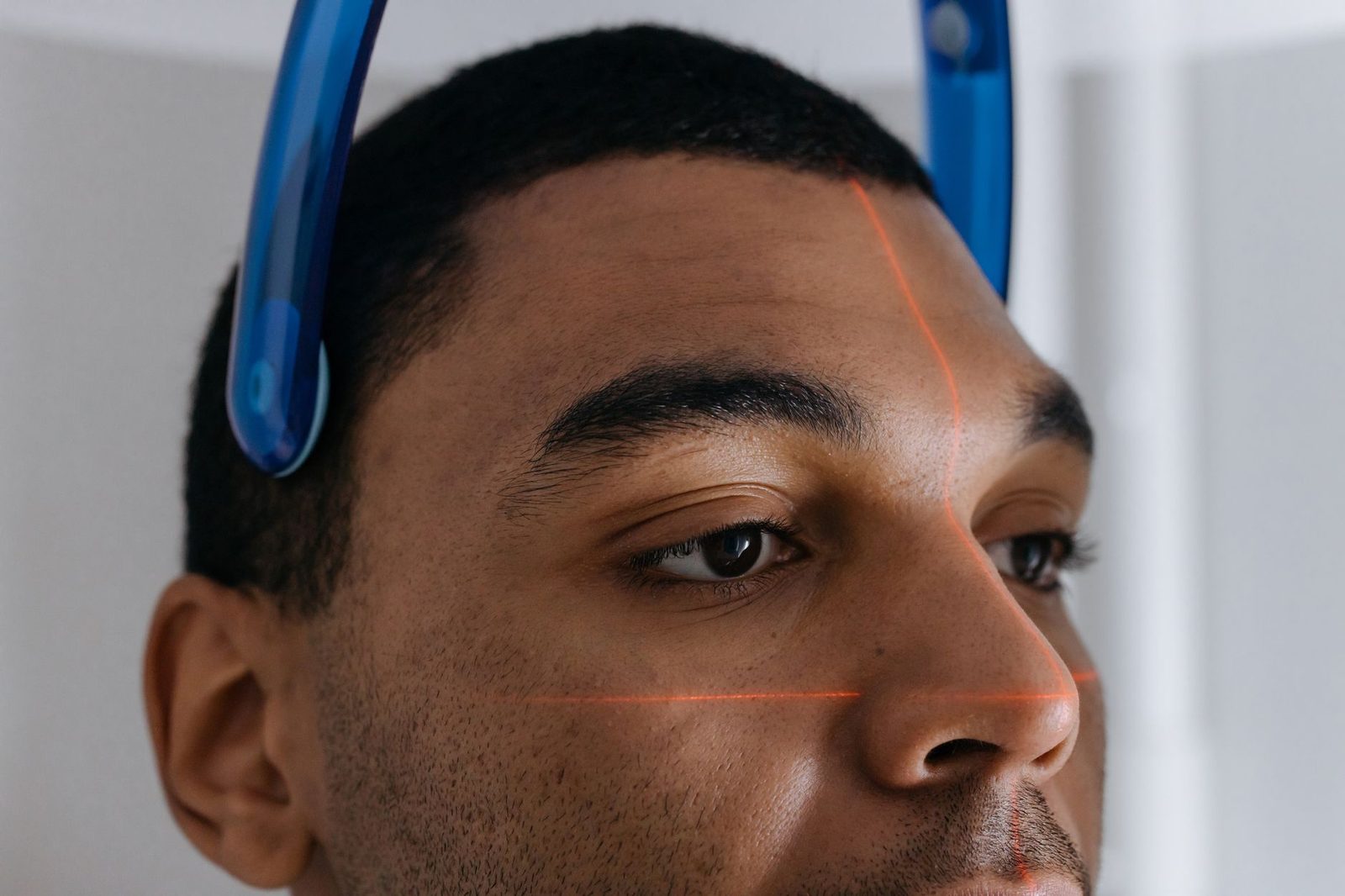
It is easily forgotten: the age check is the point in the whole session where your face is most clearly exposed. During the conversation, an adult can play with framing, angle and light. During verification, the system demands exactly the opposite: full face, front-on, well lit, still, often combined with a liveness test (turn your head, blink) designed to rule out printed photos and masks.
A few useful habits, none of them illegitimate:
- Take care of the background. During capture, your room is just as sharp as your face. The giveaways we listed in the article on what your backdrop reveals — an identifiable window, mail, a label — are right there in the foreground of the shot. A plain wall or a neutral foldable photo backdrop settles the matter in three seconds.
- Do the check before setting up anything else. No documents on the desk, no messaging window open behind you.
- Check who else is in the room. In a shared household, the instruction "look at the lens" draws attention. This ties in with what we wrote about sharing a family device.
- Use wired headphones when the screen announces the steps: some interfaces read the instructions out loud, and a wired headset with microphone prevents the whole room from hearing "age verification in progress".
For a couple, one check does not cover both
A rarely stated point: facial estimation authenticates one face. When a couple logs in together, the platform has only verified the person who sat in front of the lens. The terms of service of serious providers make it clear that the account holder is responsible for who appears on screen: anyone in frame must be an adult and consenting. It is the same logic of explicit consent described in our article on ground rules between couples.
The limits no model will ever cross
Three structural limits are worth knowing, because they explain why facial estimation will never fully replace documentary proof.
| Limit | Concrete consequence |
|---|---|
| The 17–22 grey zone | No model reliably distinguishes these ages: hence the safety margin and the rejection of genuine adults |
| Dependence on image quality | A mediocre webcam or backlighting cause accuracy to collapse, regardless of age |
| Vulnerability to presentation attacks | High-definition photos, replayed videos, masks: hence liveness tests, themselves imperfect |
For the first limit there is no remedy: it is a social choice between the rate of false rejections (adults blocked) and the rate of false approvals. Regulators have come down on the side of caution, and therefore of false rejections. For the second, an adult can take back control: an external 1080p webcam plugged in over USB delivers a far better image than many built-in laptop sensors, and the benefit carries over to the rest of the session — we set out the criteria in the article on choosing a webcam.

What about simply saying no?
An adult is perfectly entitled not to want to show their face to an algorithm. Two options then exist:
- Go through a double-anonymity third-party verifier, where the platform offers one: you prove your adult status to a specialist operator, which does not know where you are going, and the platform receives an adulthood token without knowing who you are.
- Don't use the service. That is a legitimate answer, and it is also a selection criterion: a service that offers only one route, the most intrusive one, says a lot about its attitude to data.
To find your way without relying on a provider's marketing, the reference reading remains the authorities themselves: the CNIL (French data protection authority) decisions and dossiers on age verification, the Arcom (French audiovisual and digital regulator) reference framework, Ofcom's guidance and NIST's FATE reports are all public and free. To go further into GDPR principles as they apply day to day, a recent edition of a practical GDPR guide saves you from flying blind through privacy policies.
Key takeaways
- Facial estimation does not identify you: it produces a probable age bracket, which makes it, when properly implemented, the least intrusive method available.
- Its accuracy hovers around 2 to 3 years of average error in the best cases, hence a safety margin that legitimately turns away genuine adults.
- The three things to check are: local or remote processing, retention or deletion of the image, and the existence of a biometric template.
- The moment of the check is the moment when your face and your room are most visible in the entire session: prepare the backdrop beforehand, not afterwards.
- One verification covers one person only; in a couple, each partner remains responsible for their own consent and their own adult status.
Facial estimation is neither a gimmick nor blanket surveillance. It is a technical compromise — imperfect and measurable — between two goals that are hard to hold together: keeping minors out of services not intended for them, and letting adults in without leaving their identity at the door.