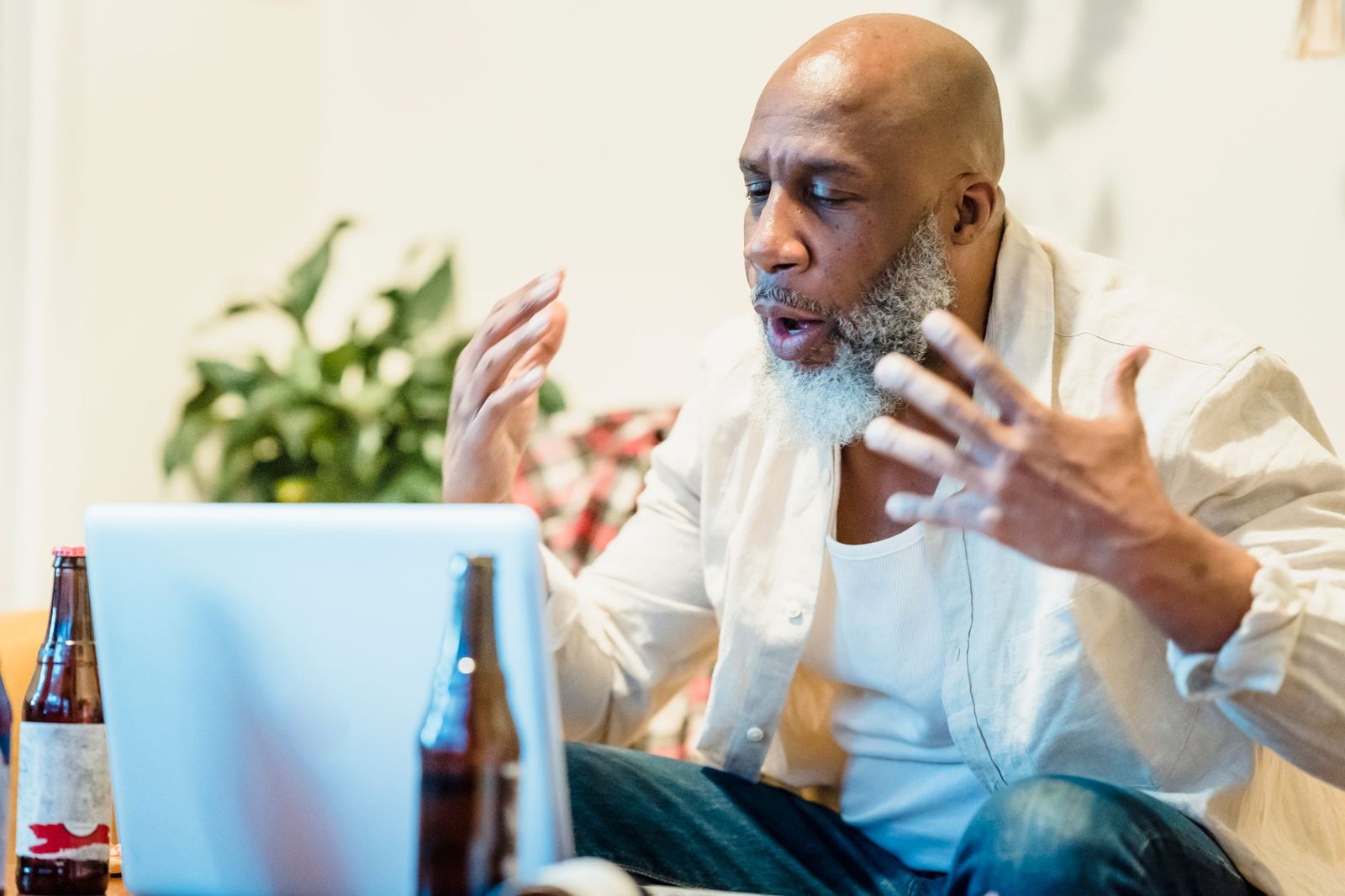
There is one category of chatroulette user nobody ever talks about: the ones who aren't after flirting, distraction or provocation, but after sentences. People who log on with a notebook open beside the keyboard, who jot down an expression they've just heard, who run through the same self-introduction three times to see which version lands best. There are more of them than you'd think, and they have grasped something the rest of the educational web takes years to admit: conversation with a stranger — no stakes, no grade, no teacher — is one of the most effective spoken-language learning environments there is.
The paradox is a pretty one. Random video chat has a reputation as a digital wasteland, and yet it is the only setup where someone in Roubaix can, in twelve seconds and without spending a penny, end up face to face with a native speaker from Osaka, Bogotá or Warsaw who has nothing better to do than chat. No language school offers that. No app does either — certainly not for free, and not at 11 p.m. on a Tuesday.

Why speaking resists every classic method
The gulf between understanding and speaking
Any French school-leaver has had seven years of English. Most of them follow the gist of a subtitled series and then freeze in front of a waiter in London. The Council of Europe, through the Common European Framework of Reference for Languages (CEFR), distinguishes five language activities precisely: listening comprehension, reading comprehension, spoken interaction, sustained spoken production and writing. French schooling has long favoured the first two and the last. Spoken interaction — where you have to answer now, unprepared, coping with the unexpected — is the one that gets sacrificed.
And that is exactly the skill random video chat trains, and pretty much the only one. You can't hit pause. You can't reread. You have to produce an intelligible utterance within two seconds, or watch the other person click Next. It's brutal, and it's precisely the missing stimulus.
The output hypothesis, or why listening isn't enough
In the 1980s, Canadian linguist Merrill Swain formulated the output hypothesis in response to Stephen Krashen's work on comprehensible input. Her observation grew out of field evidence in Canada's French immersion programmes: English-speaking pupils exposed for years to high-quality French understood beautifully… and produced approximate, fossilised French.
Her conclusion: producing language forces a level of cognitive processing that mere listening does not require. When you listen, you can make do with the overall meaning. When you have to speak, you're obliged to pick a tense, an agreement, a preposition. And above all, you discover in real time the hole in your competence — what Swain calls noticing the gap. You want to say "je m'en fous" in English, you can't find it, you improvise, the other person reformulates: I don't care. That expression you will never forget again.
A chatroulette is a machine for mass-producing noticing the gap. A forty-minute session generates more of it than a month of passive podcasts.
What a random encounter offers that a class doesn't
A variety of accents, for free
Commercial audio courses use professional voices, well articulated, recorded in a studio. Reality sounds different. The English you'll hear on a cam-to-cam platform is that of an Indian, a Nigerian, a Texan, a Dutch speaker whose English beats half of Britain's. That exposure to variation is a skill in itself: international English today is spoken mostly by non-natives, and being able to decode an unexpected accent is worth more than being able to imitate the BBC.
Emotional stakes at just the right level
Speaking in front of a class is terrifying because the judgement lingers. Speaking to a stranger who'll vanish in three minutes is uncomfortable but inconsequential. That asymmetry is precious: the brain is engaged enough to remember (emotion consolidates the memory trace — a well-established finding in the neuroscience of memory) and relaxed enough to dare.
A mistake on random video chat costs nothing. It's the only classroom in the world where you can get it wrong in front of someone you'll never run into again.
Negotiation of meaning
That's what language teaching specialists call the moment when two speakers fail to understand each other and work together to repair the exchange: repetition, rephrasing, gestures, typing in the text chat. Michael Long, in his interaction hypothesis, makes it the main engine of acquisition. These micro-repairs are impossible with a YouTube video. They're constant as soon as a real human is sitting opposite you.
A concrete five-step method
1. Set one goal per session, and only one
Logging on "to practise" leads nowhere. You end up speaking your own language to fellow natives. Decide before you open the page: tonight I use the English present perfect in every exchange, or tonight I ask three open questions per conversation. A single goal, measurable, verifiable.
A spiral notebook sitting beside the keyboard is still the most effective tool for this — writing by hand while you talk is more discreet than opening a word processor window, and handwriting aids retention according to several studies in cognitive psychology, notably Mueller and Oppenheimer's work on note-taking.
2. Prepare three solid openers
The opening is the costliest moment. If you're groping for words in the first two seconds, your partner clicks. Prepare and memorise three opening lines in the target language — tested, fluent, delivered without hesitation:
| Goal | Sample opener | Effect |
|---|---|---|
| State your intention | "Hi! I'm learning English, can I practise with you?" | Defuses judgement, often earns goodwill |
| Create a geographical anchor | "Where are you from? I've never talked to someone from there" | Opens an inexhaustible topic |
| Trigger a reaction | "Quick question: coffee or tea?" | Prompts an instant reply |
Announcing that you're learning changes everything. In practice, a significant proportion of partners become noticeably more patient, slow down and correct you spontaneously. You're no longer asking for a conversation, you're asking for a favour — and plenty of people enjoy doing favours.
3. Work on intelligibility before grammar
On a compressed connection, a poorly articulated consonant disappears. The limiting factor is almost never your grammar, it's your audibility. A noise-cancelling USB headset will improve the quality of your language exchanges faster than three chapters of verb conjugation: when the other person hears you clearly, they answer; when they have to guess, they move on.
Articulate more than usual, speak a little more slowly than your natural pace, and don't fear silences: they land better on video than on the phone, because the face keeps communicating.
4. Use the text chat as a safety net
That little text box is the learner's best ally. Get the word you didn't catch typed into it. Copy it. A word both read and heard sticks twice as well as a word only heard. Many effective learners keep a flashcard session open in a tab and dump their finds into it over the course of the evening.
5. Sort things out after the session
Twenty minutes of conversation produce a dozen scraps scribbled in haste. The next day, go back over them, check them in a reliable bilingual dictionary, and keep only five. Five genuinely assimilated expressions a week is two hundred and sixty a year. That's enormous.
The mistakes that cost you months
Hunting for the perfect native speaker
Many learners spend their session clicking Next in search of the ideal native: patient, cultivated and available. They speak for four minutes out of sixty. A high-level non-native speaker is often a better partner: they speak more slowly, articulate more, know the difficulty from the inside and won't be irritated by a misplaced preposition.
Translating in your head non-stop
The reflex of translating from your mother tongue into the target language is a huge brake. The remedy is counter-intuitive: lower your ambition. Don't try to say what you'd say in your own language, say what you already know how to say in the target language. This "strategic simplification" frees up fluency, and complexity comes back on its own with time.
Logging on without headphones in a noisy space
Audio feedback, echo, background noise: so many reasons for the other person to leave without explanation. A pair of wired earbuds with a microphone is more than enough and avoids the Bluetooth latency problems that chop up the start of your sentences.
Confusing quantity with regularity
Three hours on a Sunday is worth less than twenty minutes every evening. Memory consolidation depends on sleep and spaced repetition, not endurance. The CEFR, like most frameworks, in fact reasons in terms of regular cumulative hours, not marathons.
A word on safety and etiquette
Learning a language exempts you from no precaution. The usual rules of random video chat still apply: no surname, no address, no workplace, a neutral background, and an immediate exit from any exchange that goes off the rails. France's data protection authority, the Commission nationale de l'informatique et des libertés (CNIL), regularly reminds users to be careful with live communication platforms and the personal data they let slip without thinking.
One practical detail: if you share your screen or show your notebook, check what's on it. A stick-on webcam cover is as useful between two sessions as a reminder about what you leave lying around in the camera's field of view.
On etiquette, two principles are enough:
- Announce, don't impose. Saying you're learning is honest; turning the other person into a non-consenting teacher for twenty minutes is not.
- Give back. Plenty of partners are learning your language too. Offering ten minutes in each language turns a favour into an exchange, and it's by far the format that produces the longest conversations.
How long before you see results
Don't expect a miracle in a fortnight. That said, learners who stick to a routine of four or five weekly sessions of twenty to thirty minutes fairly consistently describe the same curve:
| Period | What changes |
|---|---|
| Weeks 1–2 | Opening anxiety drops, the first few seconds stop being an obstacle |
| Weeks 3–6 | Common phrases become automatic, less mental translation |
| Months 2–4 | Clear comprehension of varied accents, ability to revive a conversation |
| Beyond | Humour, irony and nuance appear — the real threshold |
That last point is the most telling. You only truly speak a language the day you manage to make someone laugh in it. No textbook will get you there; only an accumulation of imperfect conversations with strangers.
To give all this some structure, a pocket-sized conversation course in a foreign language remains a good complement: it supplies the structures, the chatroulette supplies the field. Either one on its own leaves the learner halfway there.
In practice, tonight
Open a cam-to-cam platform, write down a single goal on a sheet of paper, prepare your opener, plug in a decent headset and give yourself twenty minutes. You'll meet people in a hurry, curious people, people who don't speak the language you were after. You'll make three mistakes per sentence. And you'll make more progress in spoken interaction than in a week of fill-in-the-blank exercises.
Random video chat doesn't replace structured learning: it's the missing testing ground for it. Vocabulary is learned sitting down, alone, with a course book. It only becomes a language the moment someone, somewhere, answers you.